For many insurers, the challenge is no longer collecting data. The real challenge is making sense of it. Over the years, insurance organisations have invested heavily in policy administration systems, claims platforms, finance applications, actuarial software, broker portals, and third-party integrations. Most of these systems were introduced independently to address specific operational needs at different stages of growth, rather than being designed to operate within a single connected ecosystem.
The result is a fragmented operational environment in which critical information is scattered across disconnected systems. Teams spend significant amounts of time locating, validating, and reconciling data before they can begin analysing it. Reporting cycles become slower, operational visibility decreases, and confidence in business data starts to erode.
InsurePulse was created to address this problem directly. Instead of requiring insurers to replace existing infrastructure, the platform connects legacy systems and consolidates fragmented information into a single, unified data environment that enables faster reporting, greater visibility, and more informed decision-making.
The Hidden Operational Burden of Fragmented Insurance Systems
The insurance industry has spent decades building increasingly complex technology estates. Most organisations now operate a mixture of legacy systems, modern applications, third-party tools, and specialised platforms that support different areas of the business.
A single insurer may operate:
- A policy administration platform
- Separate claims management systems
- Finance and actuarial databases
- Reinsurance platforms
- Broker portals
- Compliance and regulatory tools
- Customer communication systems
While each platform serves an important purpose, very few communicate seamlessly with one another. The issue is often underestimated because the data technically exists. However, if teams cannot access or trust that information quickly, its value is significantly reduced.
This creates silos of information across the organisation, making it difficult to gain a consistent and accurate view of operational performance.
The Operational Impact of Legacy Data Environments
Duplicate Records and Inconsistent Information
One of the most common problems within fragmented environments is inconsistent customer data. A single policyholder may appear under multiple variations across systems due to formatting differences, abbreviations, manual entry errors, or incomplete records.
For example:
- Jon Smith
- John A Smith
- J Smith
Although these records may represent the same individual, disconnected systems often treat them separately. This creates significant reconciliation work for operational teams and reduces confidence in analytics and reporting outputs.
As a result, organisations frequently experience:
- Duplicate records
- Inaccurate reporting
- Reduced customer visibility
- Increased manual validation
- Higher operational overheads
Teams often spend more time correcting data than extracting insight from it.
Manual Reporting Processes That Slow the Business
In many insurance organisations, reporting remains highly manual. Data must often be extracted from multiple systems, transferred into spreadsheets, reformatted, and reconciled before reports can be finalised.
Even relatively straightforward reports may require collaboration across several departments and systems before they can be completed accurately.
This creates delays across:
- Board reporting
- Financial analysis
- Regulatory submissions
- Operational dashboards
- KPI reporting
A single delayed dataset can impact an entire reporting cycle. By the time reports are completed, the information may already be outdated, reducing its value to decision-makers.
Regulatory Reporting and Data Governance Challenges
Modern insurance regulation continues to increase pressure on organisations to maintain accurate, transparent, and traceable reporting processes.
Frameworks such as IFRS 17 require insurers to demonstrate:
- Where data originated
- How it was transformed
- Which systems contributed to the calculations
- How the final outputs were produced
Within fragmented environments, tracing data lineage becomes a highly manual and time-consuming process. Compliance teams are often forced to investigate multiple systems, spreadsheets, and reporting layers simply to validate individual figures.
Without a unified data framework, insurers face:
- Increased compliance risk
- Delayed reporting cycles
- Greater audit complexity
- Higher operational costs
- Reduced governance visibility
Missed Insights and Hidden Risk Indicators
Disconnected systems do more than slow reporting. They also prevent organisations from identifying valuable operational insights.
When datasets remain isolated, linked trends often go unnoticed. For example, a rise in policy cancellations may appear routine when viewed only within policy administration systems. However, when combined with claims data, it may reveal that customers are leaving after poor claims experiences or delayed settlements.
Without integrated analytics, insurers may fail to identify:
- Emerging operational risks
- Customer retention issues
- Fraud indicators
- Claims leakage patterns
- Product profitability trends
The information already exists within the organisation, but the business lacks the visibility needed to connect it effectively.
IT Bottlenecks and Limited Agility
Legacy systems frequently place enormous pressure on internal IT teams. Business users often rely on technical departments to:
- Build reports
- Create dashboards
- Modify ETL processes
- Extract datasets
- Resolve reporting inconsistencies
Even simple reporting requests may require technical involvement, creating delays across the organisation.
As demand for data continues to grow, IT teams become overwhelmed with operational support work rather than focusing on strategic transformation initiatives. This limits agility and slows decision-making across the business.
The Rising Cost of Maintaining Legacy Systems
Maintaining ageing technology infrastructure is increasingly expensive. Many insurers still rely on systems that require specialist expertise to support, patch, and maintain.
Operational costs continue to rise through:
- Licensing fees
- Hardware maintenance
- System integrations
- Infrastructure upgrades
- Specialist support resources
Despite these investments, organisations still struggle to access timely, accurate, and reliable information. At the same time, complete system replacement programmes are often considered too costly, risky, or disruptive to pursue.
Reporting Processes That Consume Valuable Time
In many insurance businesses, reporting remains heavily manual.
Data must often be exported from multiple systems, manipulated in spreadsheets, standardised into consistent formats, and reconciled line by line before reports can be produced. Even relatively simple management reports may depend on several departments contributing information from different platforms.
A single delayed data feed can impact the entire reporting cycle.
More importantly, by the time reports are finalised, the information may already be outdated.
Regulatory Pressure Continues to Increase
Modern insurance regulation demands transparency, traceability, and accuracy.
Frameworks such as IFRS 17 require insurers to demonstrate where data originated, how it was transformed, and how figures were ultimately calculated. Achieving this level of data lineage within disconnected systems can become an enormous manual exercise.
Compliance teams are frequently forced to trace figures across multiple databases, spreadsheets, and reporting layers simply to validate a single number.
This introduces:
- Increased compliance risk
- Delayed reporting cycles
- Greater audit complexity
- Higher operational costs
Without a unified data structure, maintaining governance becomes increasingly difficult as organisations scale.
How InsurePulse Creates a Unified Insurance Data Ecosystem
InsurePulse was developed specifically to address the operational realities of modern insurance businesses. Rather than replacing existing systems, the platform connects them through a unified intelligence layer that consolidates fragmented information into a single trusted environment.
At its core, InsurePulse creates one reliable version of enterprise data that can be accessed securely, analysed in real time, and used confidently across the organisation.
Designed for Integration Rather Than Disruption
Traditional data transformation projects are often associated with long implementation timelines, operational disruption, and extensive redevelopment work.
InsurePulse takes a different approach.
Its lightweight architecture enables insurers to connect existing systems without overhauling their technology estate. This significantly reduces deployment complexity while accelerating time to value.
The platform is built to integrate with virtually any data source, including:
- Legacy Systems
- Core Systems
- Peripheral Apps
- Online SaaS
- IoT Devices
- Social Media
- Web Scraping Inputs
- Text, PDF, Image, Audio, and Video Files
This flexibility allows insurers to unify information regardless of format or source.
Intelligent Data Integration and Processing
InsurePulse includes a robust integration layer capable of extracting, transforming, and consolidating data from multiple systems simultaneously.
Users can:
- Configure secure data connections
- Save reusable connection settings
- Execute reports dynamically
- Monitor processing progress in real time
The platform also supports parallel report execution, allowing multiple reporting tasks to run simultaneously without affecting performance.
For technical teams, advanced SQL and Python functionality provide additional flexibility. For business users, low-code drag-and-drop interfaces simplify reporting and dashboard creation.
Built-In Data Quality and Validation Controls
One of the biggest challenges in insurance analytics is ensuring data accuracy before insights are consumed.
InsurePulse addresses this through integrated validation and quality controls embedded directly within ETL pipelines.
These controls help identify:
- Missing values
- Duplicate records
- Formatting inconsistencies
- Invalid relationships
- Incomplete datasets
This ensures dashboards and reports are populated only with validated, reliable information.
Users can also upload supplementary datasets manually through Excel or CSV files, enabling additional business context to be incorporated without complex integrations.
Real-Time Dashboards Tailored to Every User
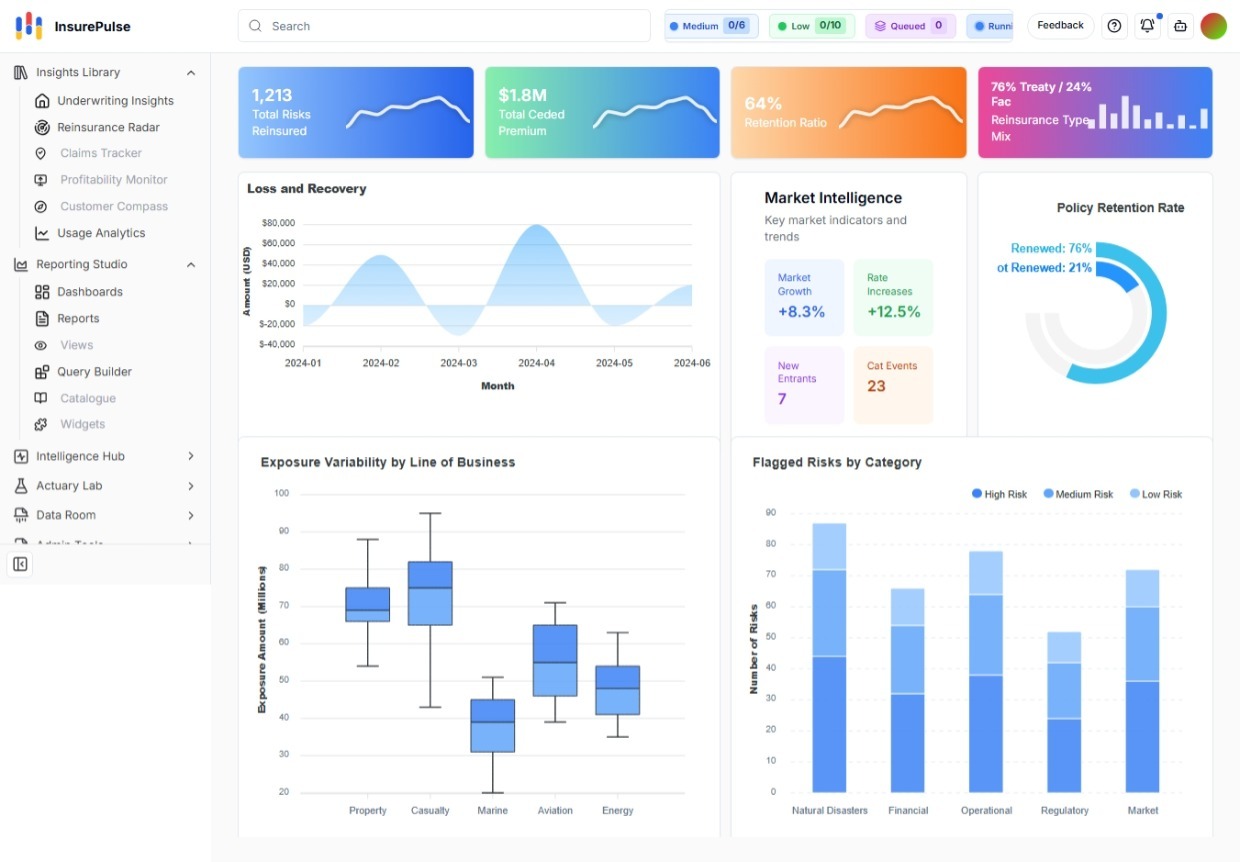
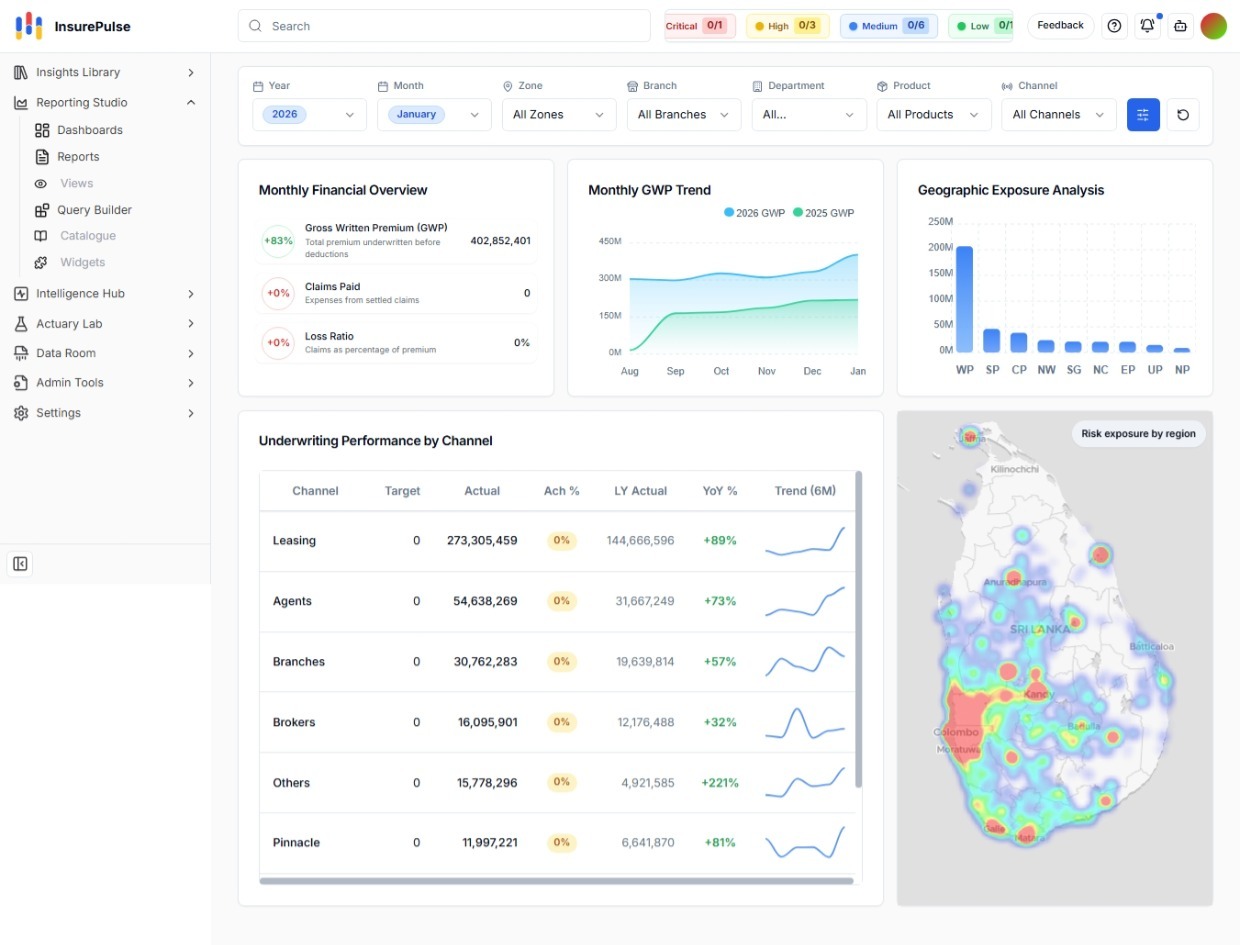
InsurePulse delivers a highly visual analytics environment designed around operational usability.
Dashboards are personalised based on user roles and permissions, ensuring individuals see only the information relevant to them. Users also have the flexibility to integrate external BI platforms such as Power BI and Tableau directly into the interface. For teams requiring greater autonomy, embedded self-service dashboard builders enable users to create their own visualisations without relying on IT support.
AI-Powered Monitoring and Insight Generation
Beyond standard reporting, InsurePulse incorporates AI-enhanced analytics to help insurers identify meaningful trends earlier.
Embedded AI-powered models continuously monitor key performance indicators such as monthly gross written premium trends, financial performance summaries, and daily quote volumes. InsurePulse also identifies anomalies by distinguishing normal operational fluctuations from genuine issues, helping insurers uncover trends, risks, and insights that may otherwise go unnoticed.
Faster Reporting With Less Manual Effort
Compared with traditional enterprise reporting solutions, InsurePulse consistently achieved significantly faster report execution times during testing.
The platform delivers highly accurate outputs by executing user-defined query logic precisely as intended. With reduced infrastructure demands and lower licensing costs, InsurePulse also offers a strong and cost-effective return on investment.
Reports can be:
- Generated automatically
- Formatted consistently
- Distributed on schedule
- Delivered before the working day begins
This not only improves efficiency but also ensures decision-makers have access to timely information when it matters most.
Enterprise Governance and Security by Design
Given the sensitivity of insurance data, governance and security remain central to the platform.
InsurePulse incorporates:
- Role-based access control
- Row-level security
- Secure VPN connectivity
- Comprehensive activity auditing
- Controlled data permissions
This ensures organisations maintain visibility and compliance while allowing broader access to analytics capabilities.
Delivering Measurable Operational Results
Insurers using InsurePulse have already seen significant operational improvements.
Teams previously limited by expensive enterprise reporting tools and slow manual processes now have immediate access to enterprise-grade analytics capabilities at substantially lower cost.
In practical terms:
- Reports that once required more than two hours can now complete in under two minutes
- Users gain earlier access to validated operational data
- Manual reconciliation effort is dramatically reduced
- Decision-making becomes faster and more proactive
Most importantly, organisations move away from reactive reporting and toward continuous operational intelligence.
“Took us 2 weeks every month to generate/collate manual reports, delaying crucial decisions. Kainovation developed real-time, web-based reports on IBM Cognos using our consolidated ODS (Operational Data Store). Thanks to them, we are more efficient, profitable, and our customers are happier.”
- Clement Fernandopulle (Fairfirst Insurance - CTO)
Meet InsurePal: Your AI Insurance Assistant
Even with unified data, finding answers can still mean navigating dashboards, filtering reports, or asking technical teams for help. InsurePal removes that final barrier.
InsurePal is the AI insurance assistant built into InsurePulse. Users ask questions about their business in plain language and receive instant answers drawn from live, governed operational data. Responses go beyond a single figure, providing the context and breakdown needed to understand what is driving performance.
InsurePal also automates the preparation of board packs and regulatory reports, reducing the recurring manual effort that slows reporting cycles across the business.
Most importantly, it puts insight directly in the hands of the people who need it. Business users no longer have to rely on IT or wait for reports to be built, and technical teams are freed to focus on more strategic work.
By combining conversational AI with real-time insurance analytics, InsurePal makes data accessible across the organisation and helps insurers make faster, more confident decisions.
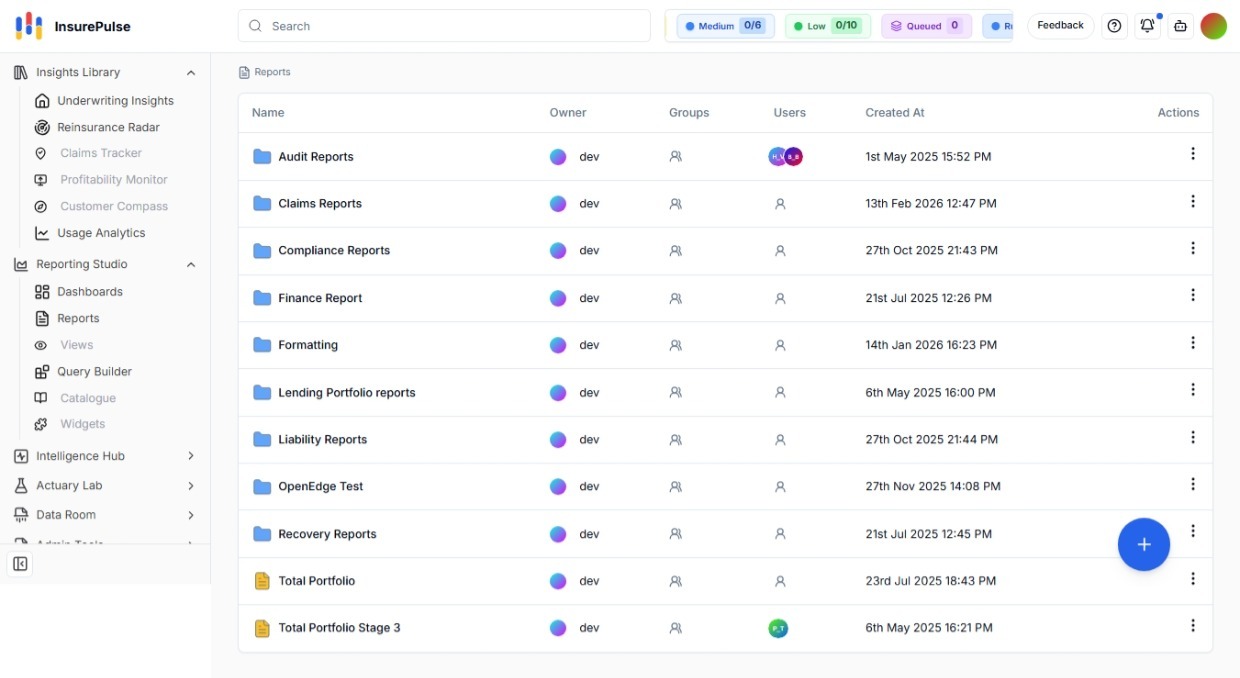
Inside InsurePulse: A Visual Overview
The Future of Insurance Data Is Connected
Insurance companies are no longer constrained by a lack of data. The challenge now is creating clarity from complexity.
Disconnected systems, fragmented reporting processes, and manual reconciliation are no longer sustainable in a market that demands speed, transparency, and precision.
InsurePulse provides insurers with a practical path forward by connecting existing systems, centralising trusted information, and enabling real-time intelligence across the enterprise.
Rather than replacing entire technology estates, the platform unlocks the value already hidden within them.
That shift changes data from an operational burden into a strategic advantage.